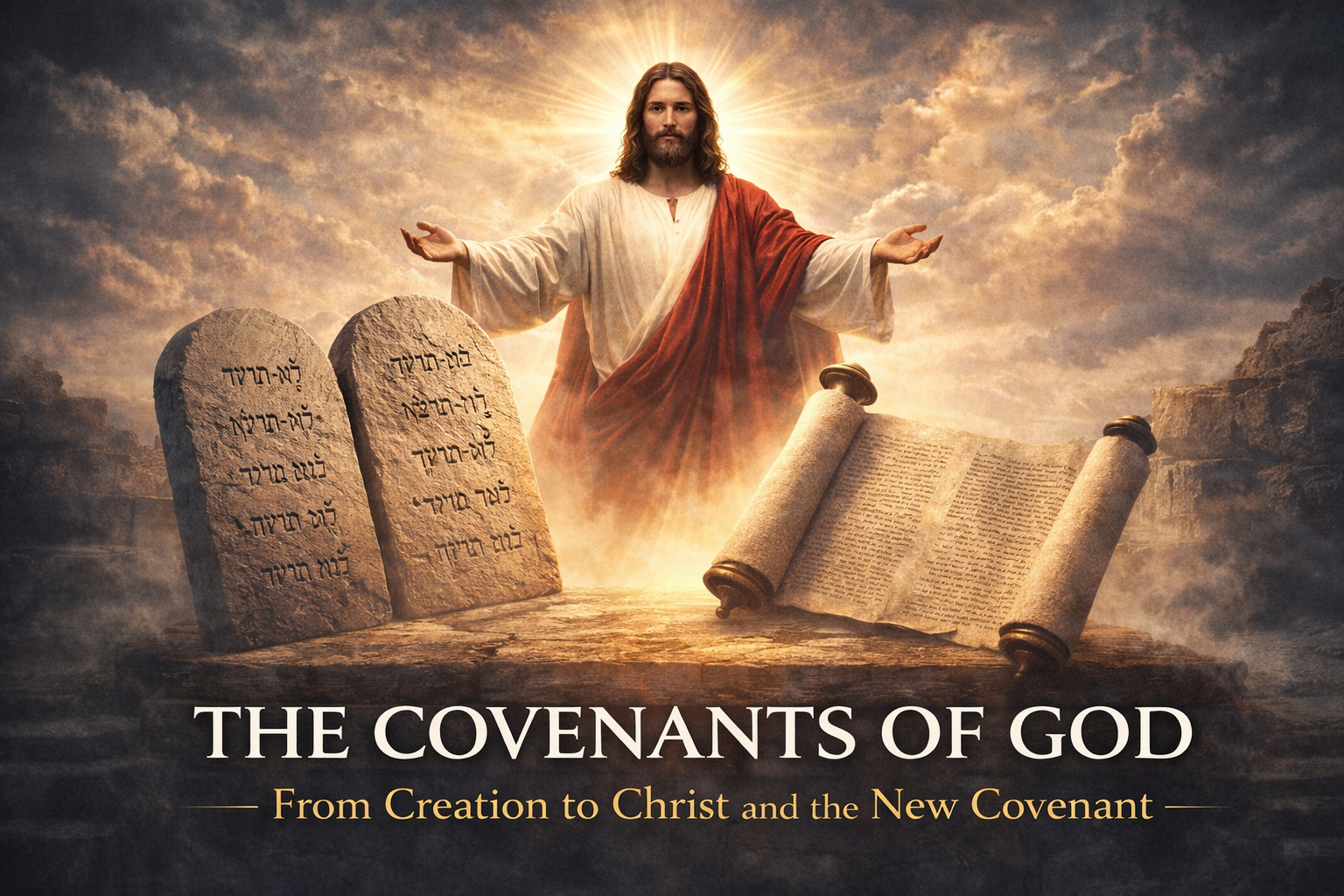
The Covenants of God
From creation to Christ: the stages of God’s moral and covenantal relationship with humanity—culminating in the New Covenant, where reconciliation with God is available to all through the sacrifice of Jesus Christ.
Covenant Judaism establishes the governing framework through which God's evolutionary relationship with humanity must be understood. The arguments concerning restoration, covenant authority, Zionism, and political legitimacy do not rest on isolated theological opinion. Scripture reveals a consistent, ordered pattern in how God relates to humanity across history—one that governs moral responsibility, covenant obligation, judgment, and restoration.
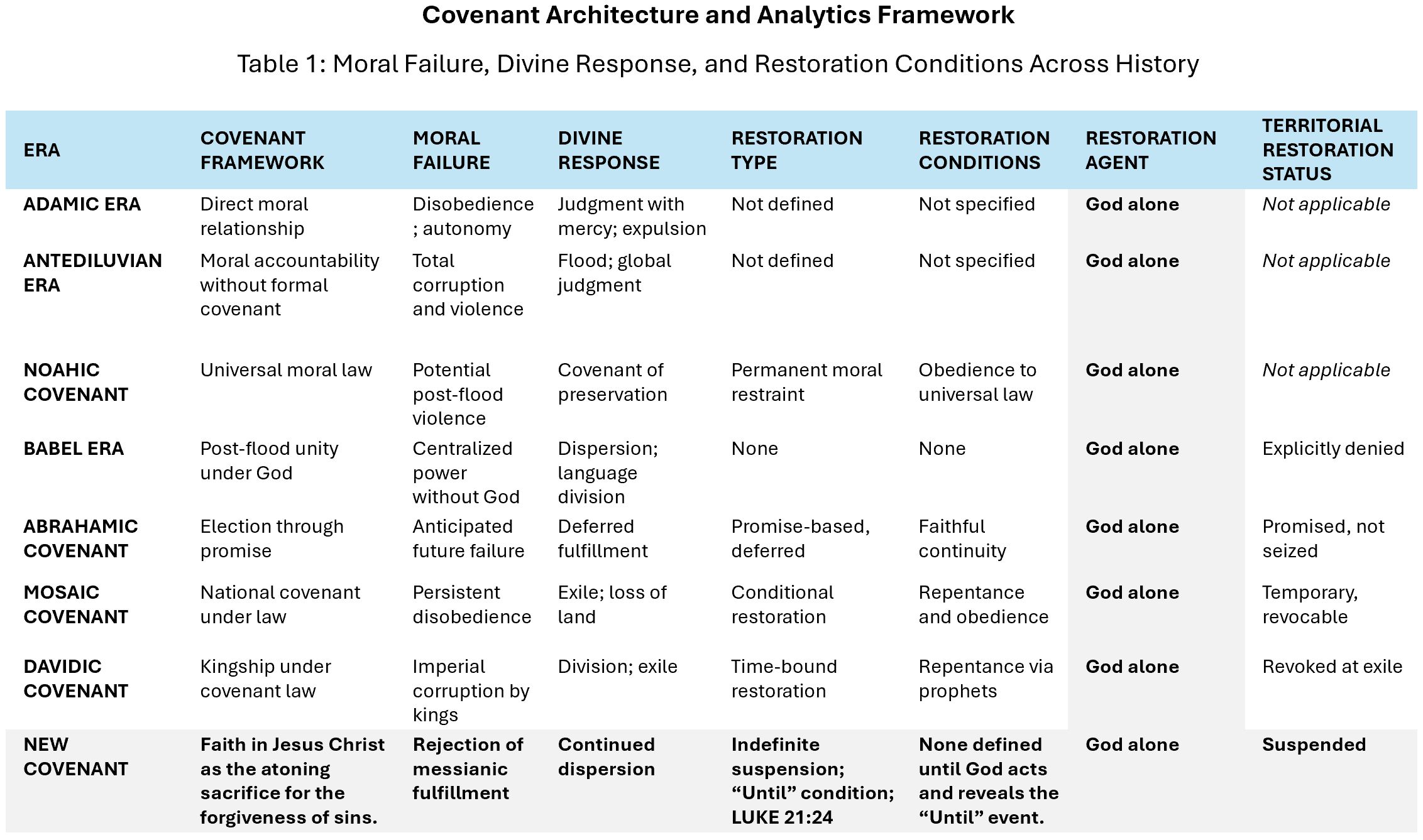
To make that structure explicit, Covenant Judaism introduces Covenant Architecture: a standardized analytical framework for documenting and evaluating the moral and covenantal phases of human history as recorded in Scripture.
Covenant Architecture treats each era according to the same criteria, allowing events separated by millennia to be evaluated on a common analytical plane. This approach ensures that conclusions regarding restoration and authority arise from pattern and consistency, not exception or preference.
The necessity of this framework becomes clear when modern claims of restoration are examined. Scripture does not treat covenant violation as symbolic, nor does it treat judgment as inconsequential. Every major moral rupture is followed by a defined divine response and, where applicable, a specified form of restoration. In some eras, restoration is immediate. In others, it is conditional, time-bound, mediated, or explicitly deferred. In at least one case—the destruction of Jerusalem and the Temple in 70 CE—restoration is suspended indefinitely until God Himself reveals His hand.
From moral order to covenant
Scripture presents a consistent pattern: revelation, corruption, judgment, and renewal. Covenant is not a political status; it is a conditional relationship governed by obedience and sustained by God alone.
Why covenant evolves
God does not change; human corruption does. As corruption escalates—from violence to institutionalized injustice—God intensifies covenantal structure, accountability, and consequence.
History of God’s covenants
| Era / Covenant | Relationship Type | Scope | Key Purpose | Outcome |
|---|---|---|---|---|
| Adamic Era | Moral relationship | Universal | Obedience without religion | Fall introduces corruption |
| Antediluvian Era | Moral accountability | Universal | Test humanity without covenant | Total corruption |
| Noahic Covenant | Moral restraint | All humanity | Preserve life; restrain violence | Judgment remembered |
| Babel Era | Political religion | Unified humanity | Centralized power without God | Dispersion |
| Abrahamic Covenant | Promise-based covenant | Lineage + faith | Restore obedience through faith | Election without entitlement |
| Mosaic Covenant | Law-based covenant | Nation of Israel | Govern national life | Exile for disobedience |
| Davidic Covenant | Kingship under law | Political leadership | Order leadership | Collapse into exile |
| New Covenant | Transformational covenant | All humanity | Internal renewal through Christ | Open-ended restoration |
The covenant we live under today
The New Covenant is established through Jesus Christ. Forgiveness of sins and reconciliation with God are available to all humanity through repentance and faith in Christ’s sacrifice. Covenant membership is not conferred by state power or administrative classification.
“My kingdom is not of this world.” — John 18:36