
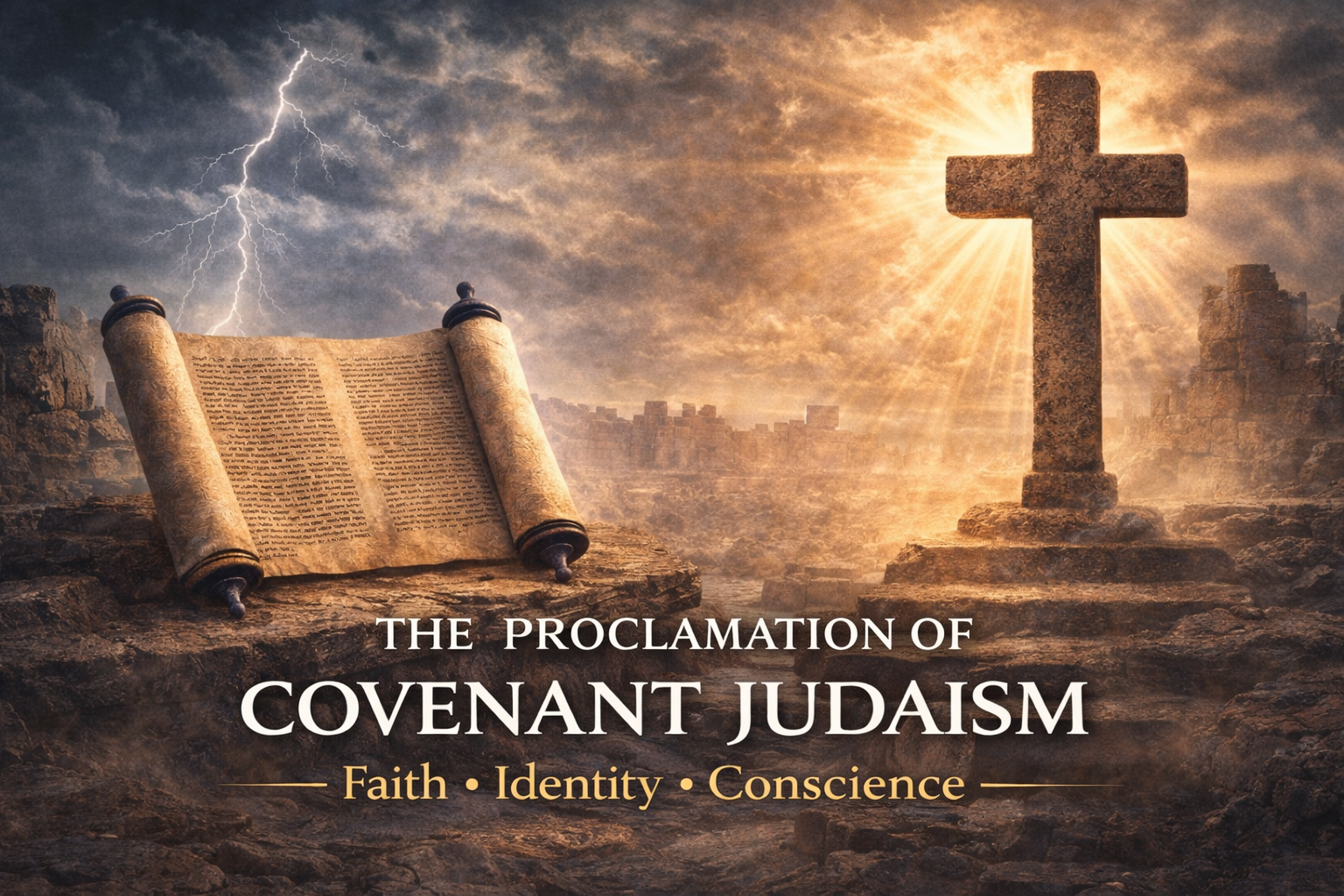
The Proclamation of Covenant Judaism
Covenant Judaism is a declaration of faith, identity, and conscience—asserting that God alone defines covenant membership, covenant legitimacy, and covenant fulfillment.
Covenant Judaism is proclaimed not as an innovation, a reform movement, or a reaction to modern conditions, but as the recognition and articulation of an enduring covenantal reality. It arises from the same covenantal logic that governed Israel from its beginning: obedience to the God of Abraham, Isaac, and Jacob, fidelity to divine command, repentance of the heart, and moral accountability before God.
The covenant was established by God, not by institutions. It preceded kingship, territory, priesthood, and nationhood. It was given to Abraham, confirmed at Sinai, renewed through the prophets, and sustained through obedience rather than bloodline or political power. Scripture consistently affirms that covenant identity is measured by faithfulness, not by ancestry alone, and by inward devotion rather than external status.
Within this covenantal history, the life and teaching of Jesus of Nazareth and the witness of his apostles occurred entirely within Jewish covenantal life. They did not introduce a foreign religion, nor did they revoke the covenant given to Israel. They testified to repentance, reconciliation, and renewal within the covenant already established by God. The expansion of covenant promise to the nations did not negate Israel’s covenantal identity, nor did it disinherit Jews who remained faithful to God while affirming that testimony.
Over time, historical upheaval, exile, and institutional consolidation produced categories that obscured this continuity. Covenant-faithful Jews were not expelled by decree, nor condemned by Scripture. They were displaced by structure, rendered invisible by classification, and excluded without formal judgment. The absence of a name became the mechanism of erasure.
This Proclamation corrects that absence. It does not create Covenant Judaism; it names it. It does not claim new authority; it acknowledges covenant continuity already present in Scripture and history. It affirms that covenantal Jewish identity did not cease, fracture, or transfer—it endured, even when unrecognized.
This Proclamation is therefore an act of recognition, not rebellion. It restores language where silence prevailed and clarity where omission governed. What follows is not a departure from Judaism, but a declaration that covenantal Jewish life has always included those who walk faithfully with God in obedience, repentance, and conscience—before institutions, beyond categories, and independent of human permission.
Authority and jurisdiction
God alone defines covenant identity. No institution—political, legal, or religious—may declare fulfillment where God has not spoken, confer covenant standing by classification, or silence covenant critique by administrative decree.
Covenant identity defined
Covenant Judaism affirms the Torah and the fullness of Scripture, including messianic fulfillment in Jesus Christ. It recognizes covenant inclusion through repentance, obedience, and faith—extending to Jews and to Gentiles grafted into covenant through Christ.
Affirmations
- The God of Israel as the sole authority over covenant and restoration.
- The authority of Scripture (Torah, Prophets, and the New Covenant witness).
- Jesus Christ (Yeshua) as mediator of the New Covenant.
- Repentance and obedience as covenant conditions.
- Waiting upon God for restoration rather than asserting it through power.
Rejections
- Secular redefinition of Jewish identity as covenant identity.
- Conflation of covenant with state power or administrative recognition.
- Use of antisemitism doctrine to silence Scripture-based critique.
- Claims of fulfilled restoration absent divine authorization.
Closing declaration
Where Scripture has spoken, Covenant Judaism submits. Where Scripture is silent, Covenant Judaism waits. Where authority is claimed without authorization, Covenant Judaism testifies.